


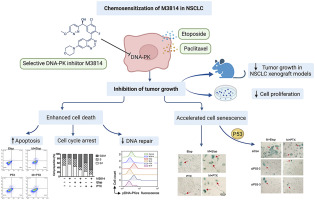
DNA-PK inhibition by M3814 enhances chemosensitivity in non-small cell lung cancer
Source : https://www.sciencedirect.com/science/article/pii/S2211383521002781?via=ihub
A significant proportion of non-small cell lung cancer (NSCLC) patients experience accumulating chemotherapy-related adverse events, motivating the design of chemosensitizating strategies. The main cytotoxic damage induced by chemotherapeutic agents is DNA double-strand breaks (DSB). It is thus conceivable that DNA-dependent protein kinase (DNA-PK) inhibitors which attenuate DNA repair would enhance the anti-tumor effect of chemotherapy.
Conlcusion/Relevance: The present study provides a theoretical basis for the use of M3814 in combination with paclitaxel and etoposide in clinical practice, with hope to aid the optimization of NSCLC treatment.
• Source: Acta Pharmaceutica Sinica B
• Relevance: “The present study aims to systematically evaluate the efficacy and safety of a novel DNA-PK inhibitor M3814 in synergy with chemotherapies on NSCLC.”
• Double-strand breaks are the main damage caused by chemotherapy. DNA-dependent protein kinase (DNA-PK) inhibitors that attenuate DNA repair could improve the anti-tumor effects of chemotherapy.
• The authors noted heightened expression of DNA-PK in human NSCLC tissues, which predicted poor prognosis. In various cell lines, M3814 potentiated the anti-tumor effect of paclitaxel and etoposide. Tumor regression was noted in various combinations of two NSCLC xenograft models. Tumor regression was also noted in vivo.
• The authors observed a P53-dependent accelerated senescence response by M3814 after treatment with paclitaxel/etoposide.
• “The present study provides a theoretical basis for the use of M3814 in combination with paclitaxel and etoposide in clinical practice, with hope to aid the optimization of NSCLC treatment,” wrote the authors. “In this study, we found that both paclitaxel and etoposide work synergistically with M3814 to induce cellular senescence so as to inhibit tumor growth.”